
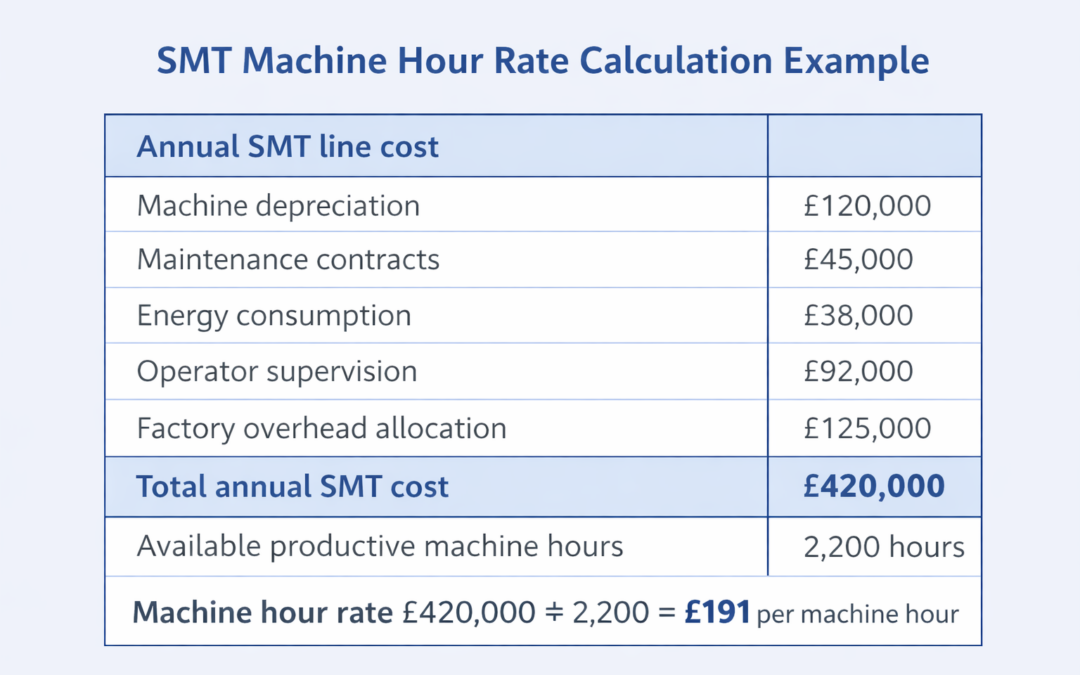
Accurate costing is critical in printed circuit assembly (PCBA) manufacturing. One of the most important figures is the SMT machine hour rate, which determines the true cost of assembling a PCB assembly or PCBA circuit board.
If the machine hour rate is wrong, the entire printed circuit assembly quotation will be wrong. In electronics manufacturing, this leads to underpriced contracts, lost margin, or uncompetitive quotes.
This guide explains how to calculate SMT machine hour rate using real production factors in SMT machines used for PCB assembly.
Download Now: Electronics Manufacturing Bottleneck Operations
What is an SMT Machine Hour Rate in PCB Assembly?
An SMT machine hour rate is the total cost of operating an SMT machine for one hour, including machine depreciation, labour, factory overhead, consumables, maintenance, and utilities.
In printed circuit assembly, every PCBA circuit board spends time on multiple SMT machines such as:
- Solder paste printer
- Pick and place machines
- Reflow oven
- AOI inspection systems
Each of these machines contributes to the PCB assembly cost per board.
To quote accurately, manufacturers must determine the true hourly cost of each machine.
For example:
| SMT Equipment | Typical Function |
| Solder Paste Printer | Applies solder paste to PCB pads |
| Pick & Place Machine | Places electronic components |
| Reflow Oven | Soldering components |
| AOI | Automated optical inspection |
Each machine has a different capital cost and operating cost, which must be reflected in the machine hour rate.
What Costs Should Be Included in an SMT Machine Hour Rate?
A correct SMT machine hour rate includes five main cost categories: machine depreciation, labour, maintenance, factory overhead, and utilities.
Many electronics manufacturers underestimate these costs when quoting PCB assembly jobs.
1. Machine Depreciation
SMT machines are expensive capital assets.
Typical examples:
| Machine | Approx Cost |
| SMT Pick & Place | £200,000 – £600,000 |
| Solder Paste Printer | £30,000 – £80,000 |
| Reflow Oven | £60,000 – £150,000 |
| AOI Machine | £70,000 – £200,000 |
If a £400,000 pick and place machine is depreciated over 5 years, the hourly depreciation cost must be included in the printed circuit assembly cost model.
2. Labour Cost
Even highly automated SMT machines require operators.
Typical SMT labour roles include:
- SMT line operator
- Production technician
- Process engineer
- Quality inspection staff
In many PCB assembly facilities, one operator may supervise 2–3 machines, so labour must be allocated correctly across the SMT line.
3. Maintenance and Spare Parts
SMT machines require:
- feeder calibration
- nozzle replacement
- vision system servicing
- scheduled maintenance
A good rule used in PCBA circuit board manufacturing is:
Maintenance cost = 3–5% of machine purchase value per year
Ignoring this cost leads to unrealistic PCB assembly costing.
4. Factory Overhead
The SMT line requires supporting infrastructure such as:
- factory rent
- lighting
- compressed air
- nitrogen systems
- MES systems
- quality control
These overheads must be allocated across all printed circuit assembly production hours.
5. Utilities
SMT lines consume significant power.
Typical utility loads include:
- reflow oven heating
- compressed air
- nitrogen for soldering
- factory electricity
These costs should be included in the SMT machine hourly rate model.
Product Costing Accountant – Skynet Accounting – Accountants For Manufacturing & Engineering
How Do You Calculate the SMT Machine Hour Rate?
To calculate SMT machine hour rate, divide the total annual operating cost of the machine by the total productive machine hours per year.
The formula used in PCB assembly costing is:
Machine Hour Rate = Total Annual Machine Cost / Annual Production Hours
Step-by-Step Example
Example pick and place machine costing:
| Cost Element | Annual Cost |
| Machine depreciation | £80,000 |
| Labour allocation | £35,000 |
| Maintenance | £12,000 |
| Overheads | £20,000 |
| Utilities | £8,000 |
Total annual cost:
£155,000
If the machine runs 2,000 production hours per year:
Machine Hour Rate = £155,000 / 2,000
Machine hour rate:
£77.50 per hour
This rate becomes the base for calculating PCBA circuit board assembly cost.
How Does SMT Machine Hour Rate Affect PCB Assembly Cost?
The SMT machine hour rate directly determines the manufacturing cost of each printed circuit assembly board.
Once the hourly rate is known, the cost per board depends on:
- placement time
- component quantity
- PCB size
- line efficiency
- batch size
Example:
If a PCB assembly job takes 30 seconds placement time, then:
Production rate = 120 boards per hour
If machine rate = £77.50/hour
PCB assembly cost contribution:
£77.50 / 120 = £0.65 per board
This calculation is fundamental when quoting printed circuit assembly production.
How We Approach SMT Costing in Electronics Manufacturing
In real PCBA manufacturing environments, accurate costing requires more than a simple spreadsheet.
When we analyse SMT machine hour rates, we typically start by:
- Mapping the entire SMT production line
- Calculating true productive hours
- Allocating labour across multiple SMT machines
- Including downtime, changeover and maintenance
- Calculating cost per placement and cost per board
For example, on a typical high-speed SMT line producing PCB assembly, the placement capacity may exceed 60,000 components per hour. However, real production efficiency is often 60–75%, which must be included in the cost model.
Ignoring these real-world factors leads to incorrect PCBA quotes.
What Common Mistakes Do Manufacturers Make in SMT Costing?
The most common mistake in PCB assembly costing is underestimating machine utilisation and overhead allocation.
Typical errors include:
- ignoring downtime
- ignoring maintenance costs
- assuming unrealistic machine utilisation
- excluding engineering support costs
- spreading factory overhead incorrectly
These mistakes distort printed circuit assembly pricing and damage profitability.
Conclusion
Calculating an accurate SMT machine hour rate is essential for any company involved in printed circuit assembly (PCBA) manufacturing.
By properly accounting for:
- machine depreciation
- labour
- maintenance
- utilities
- factory overhead
manufacturers can determine the true cost of producing a PCB assembly.
For electronics manufacturers working with SMT machines, this calculation is the foundation of reliable PCBA circuit board costing and quotation accuracy.
Book a Discover Call: https://calendly.com/skynet-skynetaccounting/new-meeting
Follow me on LinkedIn: www.linkedin.com/in/skynet-yesim-tilley
About the Author
Written by Yesim Tilley Founder of Skynet Accounting is a chartered accountant with over 20 years of experience supporting manufacturing and engineering businesses across the UK. Specialising in cost analysis, product costing, and financial strategy, she helps industrial businesses understand their numbers and make more profitable and sustainable decisions. Skynet Accounting provides tailored finance, compliance, and taxation support for business owners.