
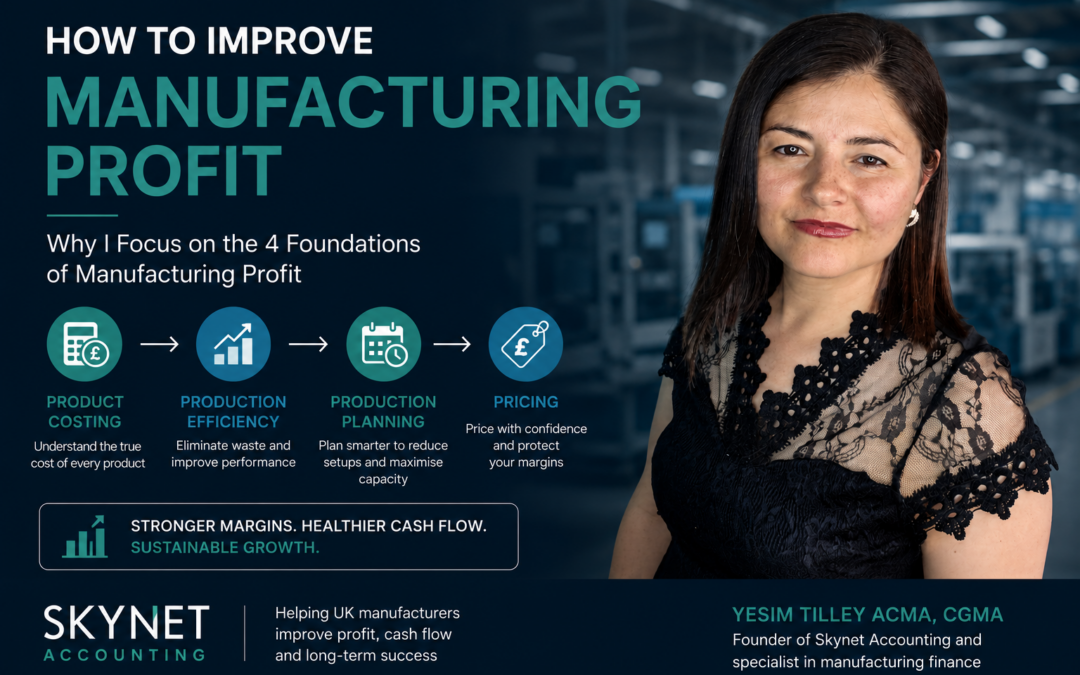
Why I Focus on the 4 Foundations of Manufacturing Profit
Manufacturers often hear the words efficiency and productivity and immediately think about producing more units. I see it differently.
For me, productivity isn’t about making more products. It’s about how effectively your manufacturing business converts those products into profit and, ultimately into cash.
After working with manufacturing and engineering businesses across Hampshire, I’ve found that the most profitable businesses build strong financial and operational foundations. That’s why I use what I call the 4 Foundation of Manufacturing Profit.
What is the best way to improve manufacturing profit?
The most effective way to improve manufacturing profit is to understand the true cost of every product, improve production efficiency, optimise production planning and price your products with confidence. These four areas work together weakness in one will affect every other decision you make.
Many manufacturers focus on reducing costs in isolation. They negotiate better supplier prices or invest in new machinery and profits still fail to improve.
The reason is quite simple. Manufacturing profit isn’t created by one decision. It’s the result of hundreds of operational and financial decisions being made on reliable information.
That’s why the 4 Foundation of Manufacturing Profit provide a framework that allows management to make decisions based on facts rather than assumptions.
Why is product costing the foundation of manufacturing profitability?
Every product should have its own costing structure. Until the complete manufacturing journey is reflected in the product cost, you cannot be certain your reported margins are accurate.
Everything starts with product costing.
If this primary foundation is wrong, every decision built on top of it will also be wrong. A robust product costing model must include every stage of the manufacturing process, including:
- Raw materials (with regularly updated supplier rates)
- Direct labour (actual time spent, not historic ideals)
- Machine time (accurate capacity and runtime rates)
- Production overheads (factory floor realities)
- Setup costs and batch changeovers
- Rework and scrap factors
Too many businesses rely on average costs or historic assumptions that no longer reflect reality. When I partner with manufacturing businesses, I begin by mapping out how products actually move through production. Without accurate product costing, pricing decisions become guesswork, capital investments become risky, and profitability analysis loses its value.
Case Study: Finding Hidden Margin for an Electronics Manufacturer
Even businesses with established ERP systems can lose significant profit when those systems fail to track how production actually operates on the shop floor.
I was asked to analyse the top ten revenue-generating products for an electronics PCB assembly manufacturer. At first glance, everything appeared under control. The business had an ERP costing system in place, material prices were updated regularly, and management believed their product profitability was secure.
But when I looked beyond the reports and followed the physical products through the factory, I uncovered a very different story.
I followed each product through its entire manufacturing journey: from material preparation through the SMT line, into secondary operations requiring manual assembly, inspection, rework, functional testing, final inspection, packaging & shipping. Every stage consumed machine capacity, labour, and overhead. Much of that journey wasn’t being reflected accurately within the product costing.
The costing system reported manufacturing variances, but it couldn’t explain why those variances existed because the root causes were hidden deep within the production process itself.
The Production Planning Bottleneck
The second major issue was production planning. Products weren’t grouped into logical product families, meaning production was scheduled largely on a reactive, make-to-order basis. Similar products weren’t manufactured together, resulting in unnecessary SMT setups, constant programme changes, and excessive machine downtime throughout the day. Those setup losses directly reduced productivity and inflated manufacturing costs.
The Result: By the end of my operational and costing review, I identified an opportunity to improve gross margin by approximately 13% without increasing sales or investing in new machinery. That margin was previously being diluted by outdated costing assumptions and hidden shop-floor inefficiencies that had gradually developed over time.
You can download your free guide about How to recover £1.6m lost revenue in PCB assembly: Electronics Manufacturing Bottleneck Operations
How does production efficiency affect manufacturing profit?
Once you know what a product should cost, the next question is what actually happened between receiving the sales order and shipping the finished product. Every inefficiency increases manufacturing costs and reduces profit.
Well-managed factories experience daily losses that are rarely visible in standard financial accounts, such as:
- Unplanned machine breakdowns
- Excessive scrap and material waste
- Time-consuming rework cycles
- Long setup and changeover times
- Backlogs, bottlenecks and waiting between operations
- Material shortages and component delays
Individually, these issues may appear minor. Collectively, they drain you’re your margins every single day.
The businesses that consistently improve manufacturing profit measure these losses rather than accepting them as an inevitable part of manufacturing.
Once actual production performance is compared against the original product costing, management can identify exactly where profitability is being lost and focus improvement efforts where they will have the biggest financial impact.
Can production planning increase profitability?
Absolutely. Even with skilled employees and modern machinery, poor production planning creates unnecessary costs that reduce productivity and profit.
I have seen many factories schedule production simply to meet customer delivery dates. While keeping customers happy is vital, an isolated scheduling approach often creates excessive setup time, changeovers, machine setups. Every time a line stops to change over for another job, valuable labour and machine capacity are lost forever.
Strategic production planning considers the entire operational ecosystem, looking closely at:
- Optimal batch sizes to balance inventory and setup times
- True machine and labour availability
- Material readiness before a job hits the floor
- Harmonised production flow and reduced changeover times
Reducing unnecessary setups unlocks more productive manufacturing hours without increasing your headcount or requiring capital expenditure. That is genuine productivity improvement.
Why is pricing the final piece of the puzzle?
Confident pricing only comes from understanding your true manufacturing costs. When you know exactly what a product costs to produce, you can protect margins and make better commercial decisions.
Many manufacturers compete purely on price without fully understanding whether each order is genuinely contributing to overheads and net profit. That is a dangerous position to sustain.
Once accurate product costing, production efficiency, and robust planning work together, pricing becomes strategic.
Instead of asking, “What price will win the order?” management can confidently ask:
- Which specific products generate the strongest gross margins?
- Which customers are genuinely profitable to serve?
- Which low-margin jobs should we decline or renegotiate?
- Where should we allocate capital for future growth?
Those data-driven conversations build resilient, highly profitable businesses.
How we help manufacturing businesses
At Skynet Accounting, I do far more than just prepare standard compliance accounts. I work directly alongside UK manufacturing and engineering businesses to help management uncover exactly where profit is being created and where it is disappearing.
My specialist approach combines deep financial insight with hands-on operational understanding. I help clients:
- Build and validate accurate product costing models.
- Identify and analyse hidden manufacturing variances.
- Systematically improve shop-floor production efficiency.
- Develop meaningful management information (MI) dashboards.
- Review and optimise production planning cycles.
- Establish data-driven, confident pricing strategies.
When you have access to reliable, real-time information, better commercial decisions naturally follow.
Final thoughts
Sustainable profitability does not come from quick fixes or slashing costs in isolation. It comes from building strong foundations. By mastering product costing, efficiency, planning, and pricing, manufacturing businesses can unlock stronger margins, healthier cash flow, and sustainable long-term growth.
About the Author
Yesim Tilley ACMA, CGMA is the Founder of Skynet Accounting and a Chartered Management Accountant with over 20 years’ experience supporting UK manufacturing, engineering and industrial businesses. Driving manufacturing profit, specialising in product costing, ERP costing validation, and financial strategy, she works directly with factory owners and MDs to strengthen margins, eliminate cash gaps, and support better commercial decision-making. She is also the author of the manufacturing finance guide, How to Unlock Cash to Fuel Manufacturing Success, available on Amazon.